The $47,000 Lesson: Why ‘Cheaper’ Heavy Equipment Almost Sank Our Mining Operation
-
Why there's no single 'right answer' for buying heavy equipment
-
Scenario A: You're a new operation with limited capital — should you always buy used?
-
Scenario B: You need high uptime — is 'premium' brand worth the premium?
-
Scenario C: You're a contractor with a fixed-price project — how do you avoid losing money on equipment choice?
-
How to figure out which scenario you're in
Why there's no single 'right answer' for buying heavy equipment
If you've ever had to make a decision about buying a crusher, an asphalt plant, or a screen deck for a mining or construction operation, you probably know the feeling: every supplier tells you their option is the best. But the real answer depends entirely on your operation's size, cash flow, and tolerance for downtime.
I've been handling equipment procurement orders for about 8 years now, and I've personally made — and documented — quite a few significant mistakes. Total wasted budget across those errors? Roughly $47,000. Some of that came from the equipment itself, a lot from lost production time and rework. Now I maintain our team's internal checklist to prevent others from repeating my errors. Here's what I learned the hard way, broken into three common scenarios.
Scenario A: You're a new operation with limited capital — should you always buy used?
The trap I fell into: In my first year (2017), I was tasked with sourcing a screening plant for a greenfield site. Budget was tight. I found a 'bargain' used Astec screen from a dealer that seemed reputable. The price was 40% lower than a new equivalent. I thought I was a hero.
But I didn't factor in the downtime. The machine had hidden wear on the bearing housings and eccentric shaft. In the first 6 months, we had three breakdowns. Each one cost about $3,200 in parts and a day's lost production. The 'savings' evaporated. Net loss including downtime? About $11,000 on that one purchase.
What I wish I'd done:
- Paid for an independent mechanical inspection before signing anything. A good inspector charges about $1,500 but can spot hidden issues.
- Asked for service records from the previous owner. If they can't produce them, that's a red flag.
- Budgeted for a major rebuild within 12 months. On a used machine under $100k, assume you'll need to replace bearings and wear parts.
This worked for us once we corrected course, but our situation was a medium-sized operation with a decent maintenance crew. If you're a smaller crew with a single machine, the calculus might be different: a new machine with a warranty might actually be cheaper when you factor in lost production days.
Scenario B: You need high uptime — is 'premium' brand worth the premium?
What I learned the hard way: In 2021, we needed a new continuous asphalt plant. The budget committee pushed hard for a mid-range brand to save 15%. I argued for the Astec Double Barrel system — it's more expensive upfront but has a proven track record for fuel efficiency and reliability. I lost that argument. The cheaper plant had burner issues in months 4, 8, and 14. Each fix was about $2,500 plus 2 days of lost production. After 18 months, the total cost of ownership was actually higher than the Astec would have been.
How to approach it:
- Ask for total cost of ownership (TCO) projections from the manufacturer. If they can't or won't provide a breakdown of expected maintenance costs over 5 years, be suspicious.
- Look at the '1000-hour maintenance cost' — not just the purchase price. For a crusher or screen, this includes liners, bearings, and wear parts. The difference between brands can be 30-40%.
- Talk to other operators in your region. A machine that works well in dry Arizona might not handle humid Louisiana conditions the same way.
To be fair, the mid-range brand wasn't bad — it just wasn't right for our application. If you're running low production volumes or have flexible scheduling, the cheaper option might work fine.
Scenario C: You're a contractor with a fixed-price project — how do you avoid losing money on equipment choice?
My biggest blunder: The disaster happened in September 2022. We were bidding on a highway project with tight deadlines. Instead of buying, I decided to lease a used Astec-X crusher from a local yard. The rate was good. But the machine's throughput was significantly below what the specs promised. We fell behind by 3 weeks. Liquidated damages cost us $15,000. The lesson: never accept a machine's capacity at face value without seeing it run under load.
For this scenario, my approach now is:
- Demand a 'witness test' — watch the equipment process material at the seller's yard for at least an hour. Measure throughput with a watch and a calculator.
- Build a 'risk buffer' into your budget. If the machine is supposed to produce 400 tons per hour, plan for 340. If it does better, great.
- Include a penalty clause in your rental or purchase agreement if the equipment fails to meet agreed-upon performance metrics within the first 90 days.
How to figure out which scenario you're in
Honestly, I can't give you a universal checklist. But here are four questions that help me decide:
- Does my project have hard deadlines with penalties? If yes, lean toward newer or OEM-supported equipment. Even a relatively low failure risk isn't worth the liquidated damages.
- Do I have a strong in-house maintenance team? If you've got skilled mechanics and a parts stock, you can take more risk on used equipment. If not, pay more for warranty.
- Is this equipment for a core revenue stream, or for a single job? For core operations (like a permanent quarry), invest in quality. For one-off jobs, leasing might make more sense — even if the rate per hour is higher.
- How many hours per year will this machine run? Low hours (under 1,000 per year) mean less wear and tear. A good used machine could last years. High hours (over 3,000) demand a machine built for that duty cycle.
I don't have hard data on how many operators make the wrong call, but based on my 8 years of experience and talking to dozens of other buyers, my sense is that about 60-70% of 'budget' equipment purchases result in higher total costs within 18 months. The savings look real on paper. They disappear when you start counting downtime, rework, and lost productivity.
The takeaway? Cheapest isn't cheapest. But that doesn't mean you always need top-tier. Match the equipment to your real situation — not your budget spreadsheet, not the salesman's pitch. If you take one thing from my $47,000 in mistakes, let it be this: the 'right' choice is the one that keeps your operation running, not the one that looks good on a purchase order.
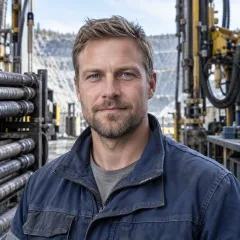
Soren Valgaard
Soren Valgaard covers surface and underground drill rigs, rotary drills, core drills, rock drills, DTH hammers, drill bits, and rock-reinforcement equipment. His evaluations reference ISO 18758-1 while comparing hole diameter, drilling depth, penetration rate, feed force, compressor demand, rod handling, fuel use, and rig stability. He helps mine engineers and equipment buyers match drilling systems to geology, bench design, production targets, operator safety, mobility, and maintenance conditions.